The was the final session of GDG DevFest 2025 for me, kind of perfect capstone to the day, providing developers with a complete roadmap from idea to production-ready AI agents.
Understanding AI Agents: The Foundation
Bhavishya began by establishing a clear definition of what AI agents are and what they bring to the table:
Core Capabilities:
- Orchestration: Coordinating complex workflows and multi-step processes
- Communication: Interacting with users, systems, and other agents
- Lifecycle Management: Managing the complete journey from initialization to completion
Key Components:
- Tools: External capabilities that allow agents to interact with systems
- LLM: The reasoning engine that powers decision-making
- Memory: The ability to maintain context and learn from interactions
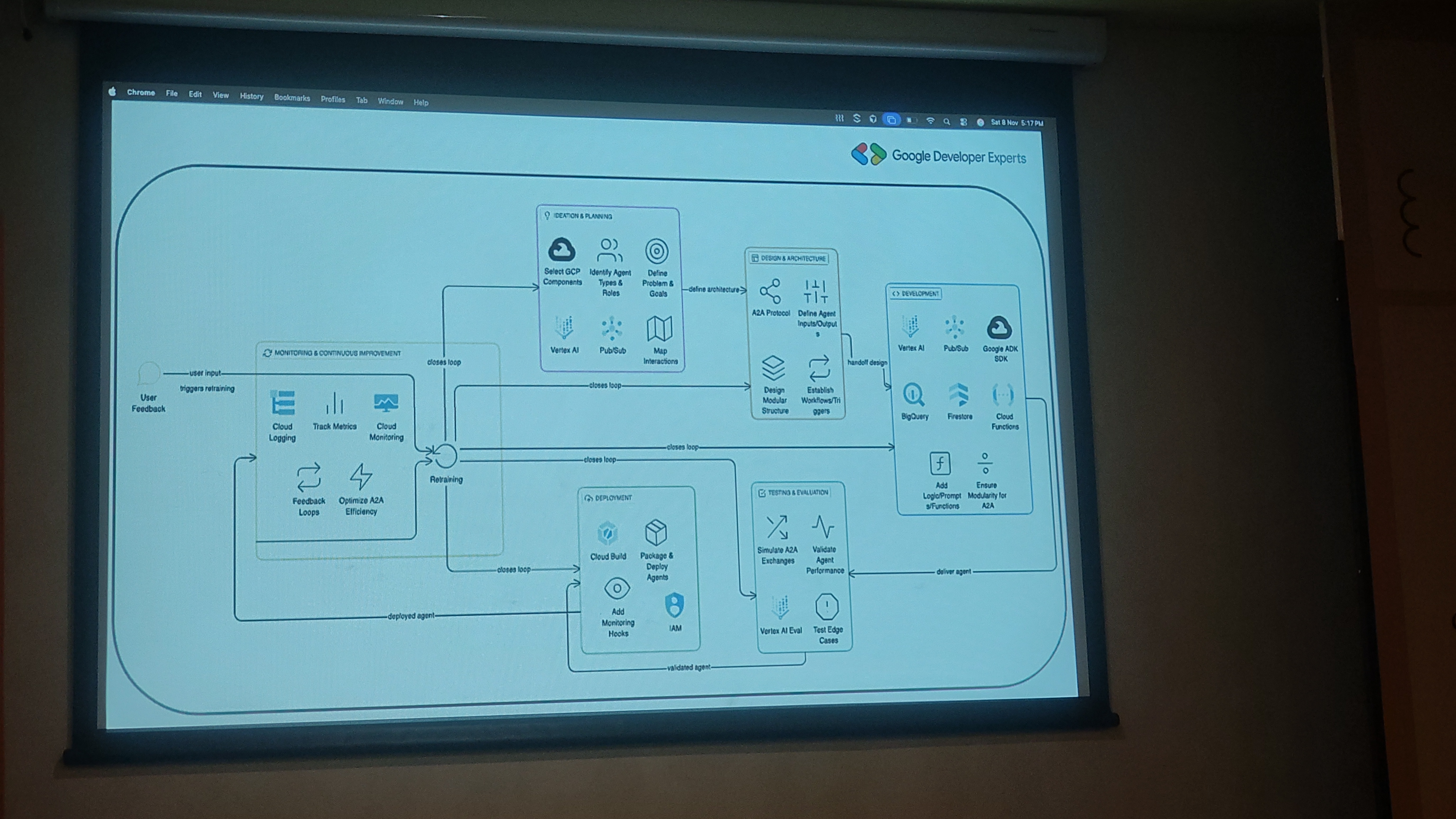
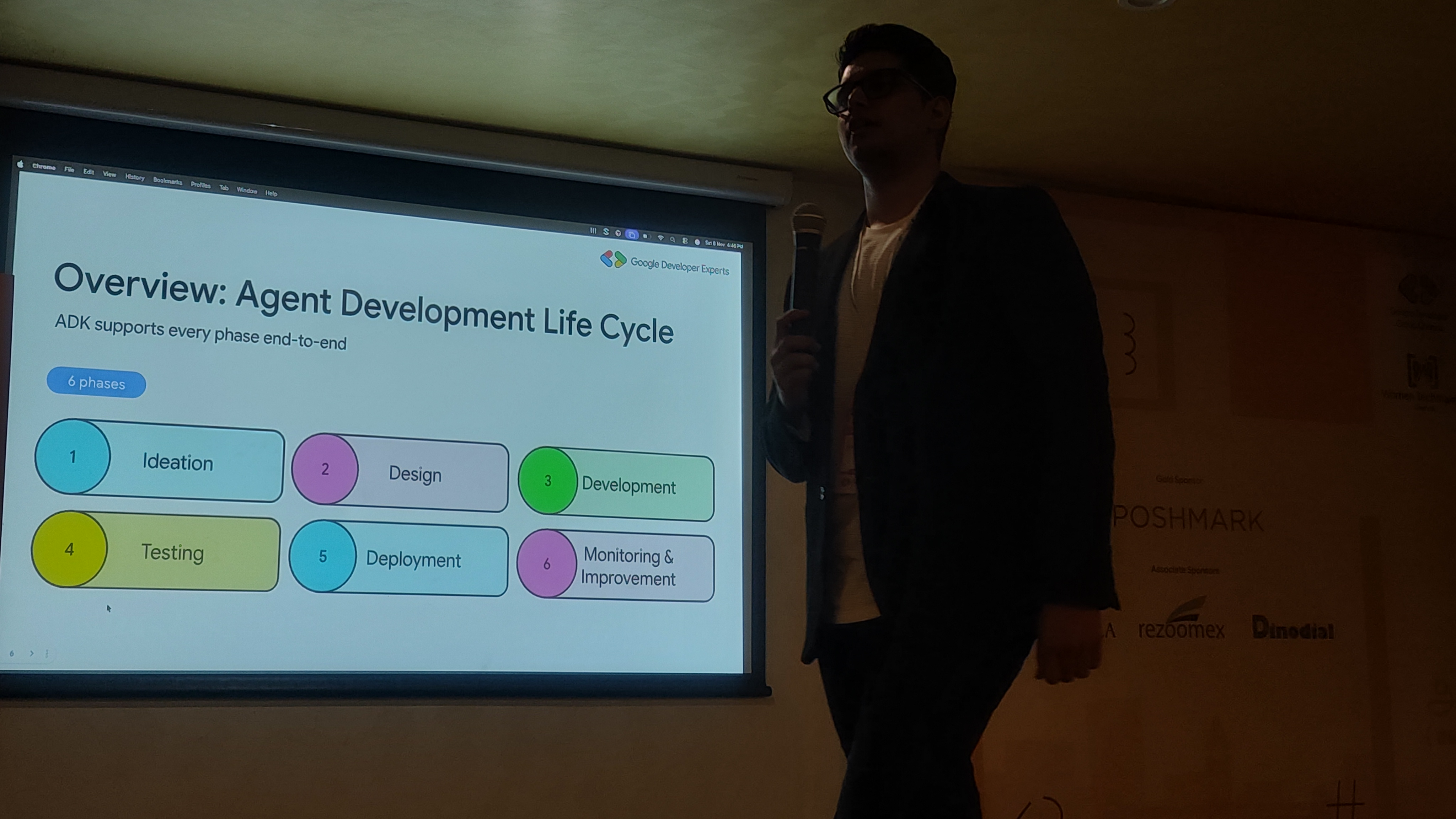
The Complete Agent Development Life Cycle
Phase 1: Ideation
-
Define Problems and Goals
-
Identify Agent Types and Roles
-
Choose Relevant GCP Components
-
Map Potential Agent Interactions
Phase 2: Design
-
Define Agent Roles, Inputs, and Outputs
-
Establish Workflows
-
Introduce A2A Protocol for Inter-Agent Communication
-
Design Scalable Module Structure
Phase 3: Development
-
Build Using ADK
-
Add Logic, Prompts, and Functions
-
Vertex AI Integration
-
Ensure Modularity for A2A Interactions
-
Implement Restrictions at File and Agent Levels
Phase 4: Testing
-
Validate Agent Performance and Interactions
-
Use Vertex AI Evaluation for Benchmarking
-
Simulate A2A Message Exchanges
-
Check Edge Cases and Failure Scenarios
Phase 5: Deployment
-
Package and Deploy Agents on GCP
-
Use CI/CD Pipelines and Cloud Hooks
-
Secure with IAM, Roles, and Monitoring Hooks
Phase 6: Monitoring & Improvement
-
Track Agent Performance Metrics
-
Use Cloud Logging and Monitoring
-
Gather Feedback Loops for Retraining
-
Optimize A2A Efficiency
Bhavishya shared an interestin perspective about
“Innovation is always Convenience.”
Common Pitfalls to Avoid
Based on his extensive experience, Bhavishya identified several common mistakes that teams make when building AI agents:
- Overloading a Single Agent
- Poorly Defined A2A Message Formats
- Ignoring Monitoring or Logging
- Tight Coupling Between Services
Best Practices for Success
To avoid these pitfalls, Bhavishya recommended several best practices:
Keep Agents Focused and Modular: Each agent should have a clear, single responsibility. This makes them easier to test, maintain, and reuse.
Use A2A Communication Effectively: Leverage agent-to-agent communication to break complex problems into manageable pieces, with each agent focusing on what it does best.
Plan for Scalability from Day One: Design your architecture to handle growth, both in terms of the number of users and the complexity of tasks.
Implement Comprehensive Testing: Test not just individual agents, but the entire system including all agent interactions and edge cases.
Prioritize Observability: Build in comprehensive logging, monitoring, and alerting from the beginning. You can’t improve what you can’t measure.
Design for Security: Implement security at every level, from individual agent permissions to data access controls and communication encryption.
Bhavishya’s session was very practical for building production-ready AI agents using Google’s ecosystem.
With a real world scenario about what could be done for a sample banking agentic flow, common pitfalls, he kept the session was lively and it was an insightful end to an amazing GDG DevFest 2025!